


Visitors to SPCA Monterey County don’t realize they are walking through the vision of a British countess who once raced automobiles across Europe, drove across Africa, reported from the Spanish Civil War, and worked with Allied intelligence before settling quietly in Carmel.
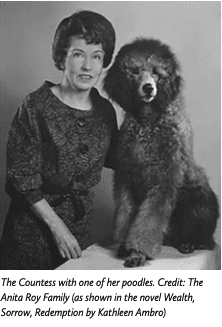
Enid Hamilton-Fellows, one of Monterey County’s best-kept secrets, might have snorted at Dos Equis’s "Most Interesting Man in the World" title. Long before seeking an artist’s life in Carmel in 1949 and becoming SPCA Monterey County’s visionary benefactor, she lived a globe-trotting, death-defying life that could have nabbed Meryl Streep a fourth Oscar.
Born in London in 1904 to a prominent tobacco family, Enid married George Hay, the 14th Earl of Kinnoull, in 1923. Enid became "the baby countess," as British media dubbed the 18-year-old, high-society newlywed. Her family’s wealth allowed for adventurous pursuits, including flying airplanes and motor racing. When she wasn’t going fast, she was painting and writing.
Their marriage dissolved by 1925, and young Enid returned briefly to London before moving to Paris. Raised Protestant, she felt drawn to Catholicism and converted in 1928, taking the name Claude after Saint Claude La Colombière.
Through Catholic associations, she met Pope Pius XI, who suggested a mission through Africa. She left on Easter Day in 1931 and returned nine months later. Serving as the primary driver, handling all mechanical repairs, and establishing six new missions, she set what was then the world record for distance traveled by automobile.
The outbreak of the Spanish Civil War in 1936 led to further international intrigue. Working as a photojournalist for the Catholic press, Claude spent six months in active war zones. Life became even more dangerous when she returned to Paris to assist the British Secret Service and French military intelligence in resisting the Nazi invasion and exposing Communist networks. Her efforts landed her on a list of high-value Nazi targets. Using her connections, she obtained an asylum visa to the United States and, ultimately, a home on Torres Street and 11th Avenue in Carmel.
Soon after her arrival, animal welfare in Monterey County changed forever.
The Countess (as she was affectionately known in Carmel) joined the SPCA’s Board of Directors in 1949. A major focus was the shelter’s dilapidated facility at David Avenue and Lottie Street in Monterey. In a 1970 book chronicling the SPCA’s first 65 years, she wrote: “The existing buildings reached a state of decay where lasting repairs could no longer be made and attempts to patch them up were a waste of money... the shelter had become a disgrace to the Monterey Peninsula.”
Efforts turned to finding a larger site, but lot after lot was discarded due to zoning restrictions or vocal neighbors objecting to an animal shelter nearby. “With heavy hearts, we gave up any hope of moving, and decided a new building must be put up on the old site,” she recalled. Early fundraising fell flat. “I set out to visit the homes of the rich,” she wrote. “One tycoon said that his only interest in animals was to obtain an elephant to live in his garden, a project which to his disgust, had been denied by local authorities.”
Bake sales, thrift shops, and wine tastings brought in meager funds, while initial dog training fees barely supported operations. The only upgrade to the old facility was a coat of paint, a “ghastly hue” sitting unwanted at a local paint shop that was practically given away. It did little to calm neighbors complaining about nighttime barking.
The shelter's prayers were answered in 1966. The Countess recalled that “a young real estate agent who was sympathetic to the SPCA’s aims brought a piece of available land to my attention.” The property, situated on Salinas Highway (now Highway 68), was slated for a housing development. “I instantly fell in love with this peaceful valley surrounded by rolling hills and lovely oaks… the land was, in every way, perfect for the permanent home of the SPCA.”
She walked the property with her poodle, envisioning bulldozers at work while sparing every oak tree possible. She mapped out where the shelter should sit and how the road would curve around the small hill.
The Countess purchased the land, named it La Vega Verde (“The Green Valley”), and donated it to the SPCA. Her vision extended well beyond dogs and cats; she declared the sanctuary would also someday house stables and a humane education center. Her ambition inspired others, including a secret Pebble Beach couple whom she referred to in her writings as "Mr. and Mrs. X," who pledged $1,500 a month.
To rally community support, SPCA board members held a public meeting in a Salinas bank boardroom. Only six people attended. One was an elderly laborer in worn clothes named Van Buren Jackson, from Lockwood in South County. Hunched over two canes, he sat in silence throughout the presentation and was the first to leave, a faint smile across his wizened face. Weeks later, the board learned Mr. Jackson had passed away and left his entire estate to the SPCA.
With Van Buren Jackson’s transformative bequest, the quiet backing of Mr. and Mrs. X, and the Countess’s unyielding determination, La Vega Verde became a reality. The bulldozers arrived, the oaks were spared, and a modern era of animal welfare in Monterey County was born.
Today, visitors to the SPCA witness the full realization of her grand vision: a vibrant, independent refuge that protects dogs, cats, horses, barn animals, and local wildlife. Enid Hamilton-Fellows – race car driver, covert asset, and Countess – found her greatest adventure in our peaceful valley.
Every healed wing in the wildlife center, every rehabilitated horse in the barn, every child who learns about the humane treatment of animals, and every adopted pet carrying a new lease on life remains a direct legacy of her fierce determination.